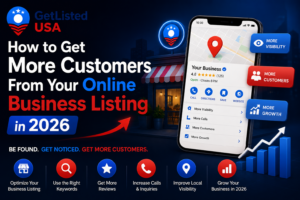

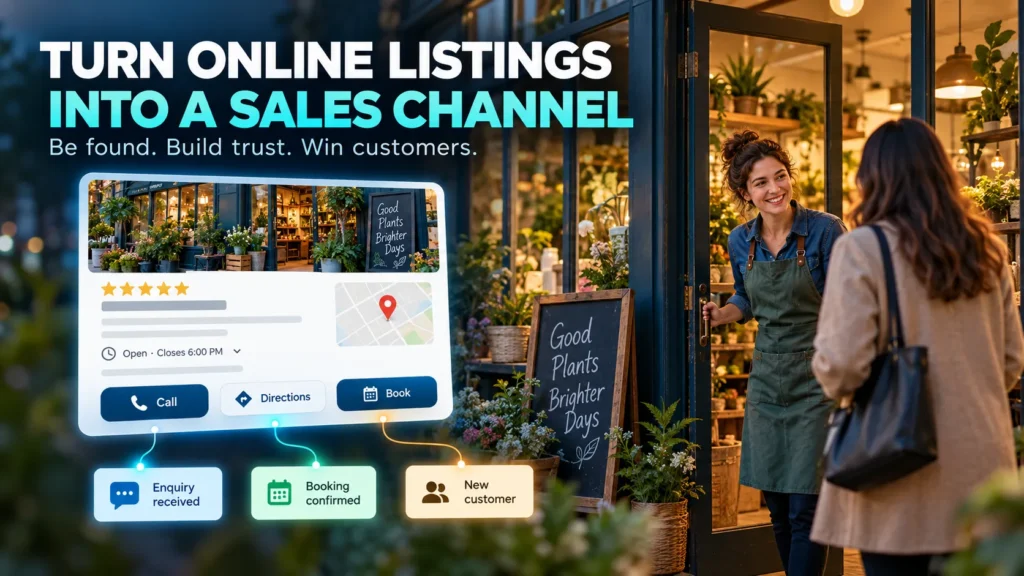
Now picture someone who needs an emergency plumber, a local restaurant, or a dentist, or a repair service. They do their research online, do some comparison shopping, review hours, reviews, photos, and who to contact. It’s rare that they ever go to the company’s website. This makes an online listing more than just a digital address book. It has the potential to be one of the first interactions between your business and a potential customer.
When small businesses stop treating listings as simple profiles and start viewing them as sales channels, the purpose changes. Your listing is now a means of communicating value, establishing trust, addressing questions, and motivating the next customer step.
From Directory Entry to Digital Sales Touchpoint
The classic method is straightforward: include the company name, address, telephone number, classification and website; claim the profile, and you’re done.
However, a sales-channel mentality sees things differently:
- What should your potential customer expect when he calls us?
- Is the listing easily understandable to readers about what we offer?
- What is the value of our business?
- What is the evidence that can minimize customer uncertainties?
- What does the visitor need to do next in the series of the story?
The aim doesn’t need to be an immediate sale. The customer can view the site, call back, request directions, email a message, or set up an appointment or obtain a quote. These are micro-conversions that take the user from researching online to a measurable conversion step.
Discovery occurs before the website visit
Local discovery is no longer a straightforward journey from search engine to website. Businesses can be located through Google Search, Google Maps, review sites, social media and other digital platforms. BrightLocal research in 2025 found that 85% of consumers indicated that contact information and hours of operation are an important part of their business research.
This experience may then be: Search, Listing, Reviews, Website or Call, inquiry, purchase instead of: Search, Website, Purchase. This means businesses must make a big impression before the prospect visits their website.
The Listing Becomes a Trust-Building Asset
You don’t necessarily attract customers to a business by being visible. In addition, customers want proof that a company is valid, applicable, and will provide what it promises. They might read the star ratings, reviews, comments, feedback, business replies, pictures, and details from various platforms.
In fact, consumers increasingly place their trust in factual information in reviews over just the star ratings, according to BrightLocal’s Local Consumer Review Survey 2025. It also found that 74% of consumers check 2 or more sites when reading reviews prior to using a local business Directory.
A large number of positive reviews does not automatically mean a business will generate more sales. What matters is the overall picture: Is the information consistent across platforms? Do the reviews appear authentic? Does the business respond professionally? Do the photos and listed services accurately represent what customers can expect?
These signals combined can help to eliminate the uncertainty in the purchasing process.
Each Listing Element Must Answer a Buying Question
One good method when improving an online listing is to think about what questions it is addressing.
| Listing element | Customer question |
| Business category | What does this business do? |
| Description | Is it relevant to my needs? |
| Location | Is it convenient? |
| Opening hours | Can I contact or visit now? |
| Phone or messaging | How can I reach them? |
| Website | Where can I learn more? |
| Photos | What should I expect? |
| Reviews | Can I trust this business? |
| Services or products | Do they offer what I need? |
Google advises leaving your Business Profiles filled and up-to-date, with your business address, hours, categories, and other information. Google also says that relevance, distance, and prominence are the main factors affecting local results.
A proper listing can educate the customer and provide the platform with a good idea of the business.
Make Listing Activity measurable actions
If the sales process includes an online listing, companies need to consider more than visibility.
Useful metrics include:
- Listing views
- Website clicks
- Phone calls
- Direction requests
- Messages
- Appointment requests
- Quote requests
It should be more than just increasing listing views. Visibility, inquiry, conversion. That’s not the formula for visibility. The formula is Visibility → Engagement → Inquiry → Conversion
Something as simple as a client viewing your listing 5,000 times and making a call to your office, clicking over to your website, directions to the business, making an appointment, or an inquiry. Tracking these actions separately gives the business a clearer picture of how listing visibility translates into customer activity
How Small Businesses Can Turn Listings Into Sales Touchpoints
You have to follow a routine to get sales from listings as:
1. Review the information
Check out the business name, address, phone number, website, hours, categories, and services.
2. Make the content better
Describe services and information clearly and easily to customers.
3. Include valuable visual material
Provide real photos of the business, products, services, location, or completed work.
4. Build authentic customer proof
Solicit and accept constructive criticism and respond to it. Google also suggests replying to reviews and adding photos or videos to Business Profiles.
- Remove friction.
Provide call, website, directions, booking, and messaging features to be easy.
6. Continue to monitor the profile.
Keep hours, services, contact information, and more up to date if the business changes.
The working principle is: Relevance and accurate information, easy action, and trust and measurement.
Don’t make these common listing mistakes
Even the sales-oriented listing can fail, if basic information is missing.
Common mistakes include:
- Establishing a profile and not changing it at all.
- Not updating contact details or hours of operation
- Using vague descriptions
- Ignoring customer reviews
- Uploading outdated photographs
- Focusing only on review quantity
Have you ever manipulated or bought reviews? Authenticity matters. Google asks companies to be accurate and adhere to their guidelines for Google Business Profile.
The objective is to be able to accurately represent the real business in the listing.
The Bigger Picture: Listings Are Part of the Customer Journey
An online listing ties to other aspects of the customer’s journey: Discovery → Listing → Trust Signals → Website / Call / Directions → Inquiry → Purchase → Review → Repeat Business
More information on the website. Reviews are customer feedback. Social platforms can provide context, and Customer Service can drive the experience following an enquiry.
The listing connects these elements when a potential customer is deciding what to do next. That makes listing management an ongoing part of the customer experience rather than a one-time submission task.
Conclusion: Stop Thinking of Listings as Digital Business Cards
An online listing can function like a digital business card, simply providing basic company information. Or it can become an active part of customer acquisition. The difference comes from how deliberately it is managed.
Keep information accurate. Explain the value clearly. Provide genuine proof through reviews and relevant photos. Simplify the next step and track users’ actions post-click. Small companies that use website listings as sales channels look beyond visibility. They concentrate on what happens as soon as somebody finds out about the company and what to make him go to the next step.