
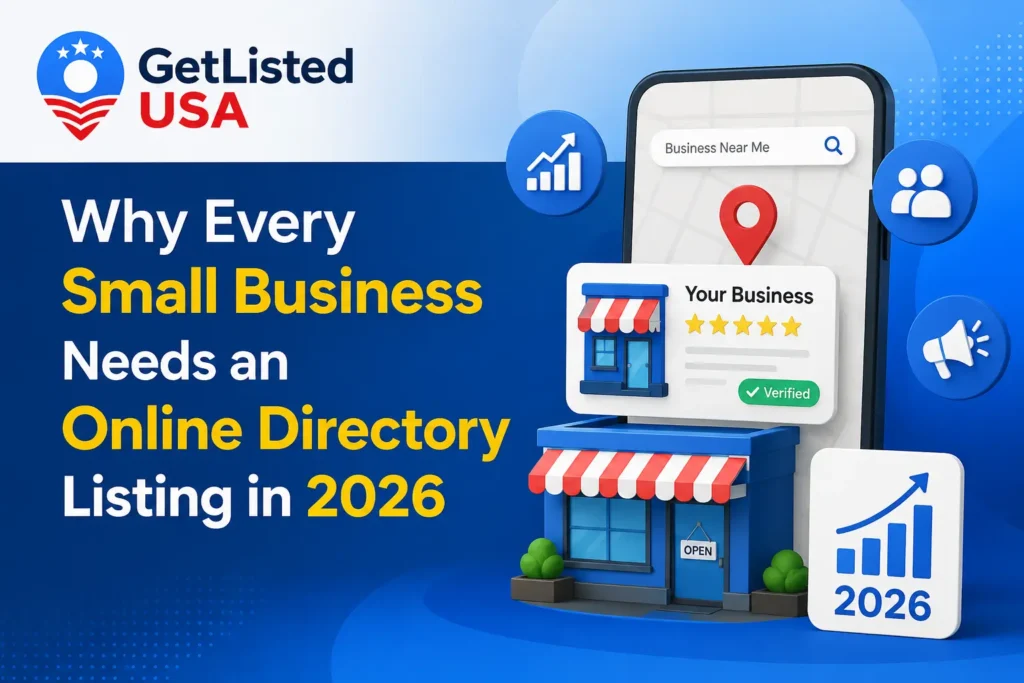
Every small business needs an online directory listing because 46% of all Google searches have local intent (Safari Digital, 2026), and businesses without directory listings are invisible to most of those searches. Directory listings build NAP citations that Google uses to verify and rank local businesses, drive direct calls and visits, feed AI search tools that 45% of consumers now use (BrightLocal, 2026), and cost nothing to create on most major platforms.
I get a version of the same question from small business owners across the country: “I have a website and a Google Business Profile do I really need to list on directories too?” The short answer is yes, emphatically. The longer answer explains why the businesses investing three hours in directory listings consistently outperform competitors who rely on a single platform.
Here’s the reality in 2026: only 64% of small businesses have a proper online presence, according to Moz. That means more than one-third of US small businesses are essentially invisible to the local searches happening around them every single day. Directory listings are the fastest, cheapest way to fix that invisibility, and the businesses that understand this are quietly winning local search while their competitors wonder why the phone isn’t ringing.
Directory Listings and Local Search Rankings
Directory listings build business citations, consistent mentions of your Name, Address, and Phone across trusted platforms. Google uses citations to verify your business is real, active, and located where you claim. The Whitespark 2026 Local Search Ranking Factors report confirms citation signals account for 7% of local pack ranking influence. NAP consistency across directories improves local rankings by an average of 23% (Moz/BrightLocal). For new businesses especially, citations are one of the fastest ways to build Google trust.
When Google’s algorithm evaluates which businesses to show in the local 3-pack for a given search, it’s looking for signals of legitimacy, relevance, and prominence. Business citations, consistent mentions of your NAP across trusted platforms are a confirmed component of that evaluation.
Think of it this way: if 30 reputable websites all independently confirm that “Garcia Plumbing” is located at “1234 Main Street, Houston, TX 77001” and can be reached at “(713) 555-0123,” Google’s confidence in that information is high. If only one website your own makes that claim, Google has nothing to verify it against.
From experience: A San Antonio cleaning service came to me after six months of terrible local visibility despite a well-designed website. When I ran a citation audit, they had exactly four directory listings. Their top competitor had 47. After building 35 targeted directory listings over 60 days including GetListedUSA, Yelp, Bing Places, and a dozen industry-specific platforms they appeared in the local pack for the first time and started receiving three to five new leads per week from organic local search alone.
Directory Listings Drive Direct Customer Actions
Directory listings generate direct customer actions beyond just search rankings. Complete listings receive 28% more customer calls than incomplete ones (SQ Magazine, 2026). Businesses with complete profiles including photos receive 42% more direction requests. 76% of mobile local searches lead to a store visit within 24 hours (BrightLocal). Free directory listings drive 61% of referral traffic to small business sites in local markets (SQ Magazine, 2026). Directory listings are not just SEO tools they are active customer acquisition channels.
Directory listings are not passive SEO infrastructure they are active surfaces where customers find you, call you, get directions to you, and decide to buy from you. Every major directory platform provides a direct call button, a website link, a map, and customer reviews. A consumer searching for “hair salon near me” on Yelp is not doing research they are ready to book. Your listing is the conversion point.
According to SQ Magazine’s 2026 data, complete free listings see 28% more customer calls than incomplete profiles. Actively managed listings those with recent photos, responses to reviews, and updated hours achieve a 2.1% average click-through rate versus 0.9% for static profiles. That’s more than double the engagement from the same search position, simply by keeping the listing current.
Directory Listings and AI Search Visibility in 2026
In 2026, directory listings feed AI search tools that 45% of consumers now use for local business recommendations (BrightLocal). When a customer asks ChatGPT “what’s the best plumber near me in Dallas?” or Google’s AI Overview responds to a local query, both systems pull heavily from structured directory data. The Whitespark 2026 report confirms citation signals account for 13% of AI search visibility factors third most important behind reviews and GBP data. Businesses with complete, consistent directory presence are more visible to AI-powered local search.
This is the most significant new development for directory listings in 2026. AI tools are not searching the web the same way humans do they are synthesizing structured data from trusted sources to generate recommendations. Directory listings, with their clean, structured NAP data, business descriptions, categories, and reviews, are exactly the kind of source these AI systems prefer.
40.16% of local business queries now trigger Google’s AI Overviews (SeoProfy, 2026). When your business has consistent, complete directory listings across 30+ trusted platforms, AI systems have more data points to identify you as a legitimate, local option for their users’ queries. When you’re listed on two platforms with inconsistent information, AI systems have reason to doubt you and omit you from their recommendations.
The ROI of Free Directory Listings vs Paid Advertising
Free directory listings deliver ongoing, compounding returns with zero ongoing cost. A business spending $500/month on Google Ads stops appearing the moment the budget is paused. A business with 50 consistent directory listings continues generating organic local search visibility indefinitely. According to research, strategic free citations boost local SEO rankings by 47% (SQ Magazine, 2026). For businesses with limited marketing budgets, directory listings are the highest-ROI local marketing activity available.
I’ve worked with businesses spending $1,500/month on Google Ads while having fewer than 10 directory listings. The math never made sense to me. Ads stop working the second you stop paying. Citations compound. Every listing you build today is still generating visibility six months, twelve months, three years from now.
According to SQ Magazine (2026), strategic free citations boost local SEO rankings by 47%. Businesses using free listings see an average 23% increase in local search visibility (Jasmine Directory research). Free submissions drive 61% of referral traffic to small business sites in local markets. These numbers reflect zero ongoing cost beyond the initial few hours of setup time.
The ROI calculation is straightforward. If building 30 directory listings takes 8 hours of your time, and those listings generate even one additional customer call per week for the next two years at whatever your average transaction value is the return is substantial. For most service businesses, it’s transformational.
How to Get Started With Directory Listings Today
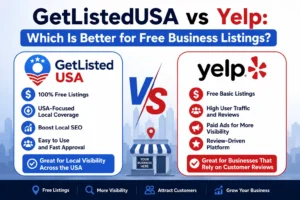
Start with Google Business Profile, then Apple Business Connect, Bing Places, Yelp, Facebook Business, and GetListedUSA in that order. These six platforms cover the majority of US local search traffic and AI recommendation systems. Have your NAP data prepared in advance exact business name, address, phone, website, hours, and a 150–300 word description. Use the same information on every platform without variation. Then expand to 30–50 total listings over time.
The barrier to getting started is genuinely low. Here’s the priority order:
- Google Business Profile claim or create at business.google.com
- Apple Business Connect claim at businessconnect.apple.com
- Bing Places claim at bingplaces.com
- Yelp claim at biz.yelp.com
- Facebook Business Page create at facebook.com/business
- GetListedUSA the GetListedUSA directory is free, takes under 10 minutes, and covers all 50 US states
For the full list of directories worth submitting to and a strategic approach, read our complete guide to US business listing sites and our local SEO guide for small businesses. For official resources on small business digital marketing, SBA.gov is the starting point.
Frequently Asked Questions
Q: Does my business really need directory listings if I already have a Google Business Profile?
A: Yes. Your GBP is the most important individual listing but Google uses citation data from dozens of other platforms to verify and rank your business. A GBP with no supporting citations is weaker than a GBP backed by 30 consistent directory listings. Think of other directories as evidence supporting your GBP’s claims.
Q: How many directory listings does a small business need?
A: Start with 6–10 high-authority platforms and complete them fully. Expand to 30–50 total quality listings over time. Quality and consistency matter far more than raw volume 20 accurate, complete listings outperform 200 inconsistent, incomplete ones every time.
Q: Can directory listings hurt my business if done incorrectly?
A: Yes inconsistent NAP data can actively hurt your local rankings. Using different phone numbers, address formats, or business name variations across directories creates conflicting signals that confuse Google’s verification system. Always use identical NAP data everywhere, and create a master NAP document before submitting to any directory.
Q: Are free directory listings as valuable as paid ones?
A: For local SEO citation value, free listings on high-authority directories are equally valuable. Paid upgrades offer additional features (priority placement, advertising, analytics) but the citation signal itself which is what helps your Google Maps ranking is the same for free and paid listings on the same platform.
Q: How long does it take to see results from directory listings?
A: Google typically crawls and indexes new listings within 2–4 weeks. Meaningful ranking improvements from citation building typically appear within 30–90 days. Full impact from a complete citation profile of 30+ listings builds over 3–6 months. The process is not instant, but it compounds indefinitely.
Your Competitors Are Already Listed Are You?
Right now, the businesses ranking above you in local search have one thing in common: they’re listed consistently across the directories your customers are searching. That’s not a coincidence. It’s a strategy and it’s one that costs nothing to implement beyond your time.
Start today. List your business for free on GetListedUSA. Build your foundation on the core six platforms. Then expand systematically using our business listing sites guide. Every listing you build today is visibility that compounds for years.