
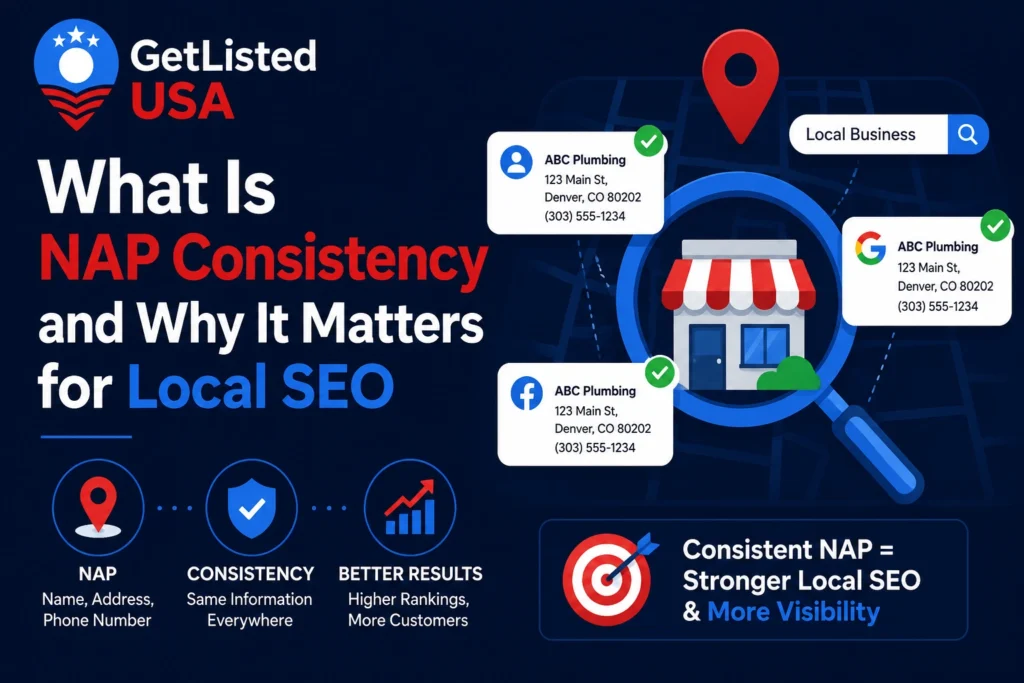
NAP consistency means your business name, address, and phone number are identical across every online directory, website, and social platform where your business appears. Search engines cross-reference NAP data from dozens of sources to verify your business’s legitimacy and location. Even minor inconsistencies like “Street” vs “St.” or a disconnected old phone number confuse Google’s algorithm and suppress your local search rankings. NAP consistency is a foundational local SEO requirement, not an optional optimization.
If you’ve ever wondered why your Google Business Profile is complete, your website is live, and you’re still not ranking well in local search, NAP inconsistency is one of the most common culprits. It’s invisible to most business owners, incredibly easy to create accidentally, and surprisingly damaging to local search visibility. It’s also entirely fixable once you know what to look for.
NAP stands for Name, Address, and Phone number. Three pieces of information every business owner knows off the top of their head. Yet across thousands of businesses I’ve audited over six years of local SEO work, inconsistent NAP data is one of the most universal problems I encounter in every city, every industry, every size of business.
This guide explains exactly what NAP consistency means, why it matters so much for local SEO rankings, the most common ways inconsistency happens, and a step-by-step process to audit and fix your NAP data across every platform where your business appears.
What NAP Consistency Means in Local SEO
NAP consistency means your exact business name, address, and phone number appear in an identical format on every online platform directories, review sites, social media, your website, and your Google Business Profile. “Identical” means character-for-character the same: same abbreviations or lack thereof, same phone format, same address structure, same business name with or without legal suffixes like LLC or Inc. Google cross-references NAP data from dozens of sources simultaneously. Inconsistencies create conflicting signals that reduce Google’s confidence in your business data and suppress your local rankings.
Think of NAP consistency as your business’s digital identity document. If your passport says one name, your driver’s license says a slightly different version, and your tax return shows yet another variation, institutions that need to verify your identity get confused even if all three are technically referring to the same person.
Google works exactly the same way with business data. It pulls NAP information from dozens of sources, directories, review sites, data aggregators, social platforms, and local news mentions and cross-references them to build a verified profile of your business. When all sources agree, Google is confident. When sources conflict, Google’s confidence drops and lower confidence translates directly into lower local search rankings.
In 2026, this matters more than ever because Google’s AI systems and AI Overview features rely on structured, consistent data to identify and recommend businesses to users. According to the Whitespark 2026 Local Search Ranking Factors report, citation signals, which NAP consistency directly impacts, account for 7% of local pack ranking factors and 13% of AI search visibility factors.
The Most Common NAP Inconsistency Mistakes
The most common NAP inconsistency mistakes are using address abbreviations on some platforms but not others (St. vs. Street, Ave. vs. Avenue); listing a business phone number that has since changed; including or excluding legal suffixes inconsistently (LLC, Inc., Co.); using shortened business names on some platforms and full names on others; and having old information persist on directories that auto-generated a listing before you claimed it. Each of these creates conflicting signals in Google’s citation verification system.
These are the NAP inconsistency patterns I encounter most frequently:
- Address abbreviation inconsistency: “1234 Main Street” on one platform vs. “1234 Main St” on another. To a human, these are identical. To Google’s data comparison algorithm, they are different strings.
- Old phone numbers: You changed your business number two years ago and updated your website and Google Business Profile, but forgot about Yelp, Yellow Pages, and 15 other directories that still show the old number
- Business name variations: “Garcia’s Plumbing LLC” vs “Garcia’s Plumbing” vs “Garcias Plumbing” across different platforms
- Suite and unit number inconsistency “Suite 200” vs “Ste 200” vs “#200” vs no suite number at all
- Post-move legacy listings: You moved locations, updated some directories, and missed others. The old address is still live on dozens of platforms.
- Auto-generated listings directories create listings from third-party data sources without your knowledge, often with outdated or slightly wrong information
From experience: A New York restaurant client moved locations after their lease ended, just three blocks away, in the same neighborhood but with a completely new address. They updated Google Business Profile immediately, but over the next 18 months, the old address persisted on Yelp, Apple Maps, Yellow Pages, TripAdvisor, and 19 other directories. Customers were showing up at the old address, leaving furious reviews about the business being “permanently closed.” Their local pack ranking dropped from position 2 to position 8. After a full NAP correction campaign across all affected directories a 60-day process their ranking recovered to position 3 within 90 days of completing the corrections.
How NAP Inconsistency Hurts Your Local Rankings
NAP inconsistency hurts local rankings by creating conflicting signals in Google’s business verification system. When Google finds different addresses, phone numbers, or business names for the same business across multiple platforms, it reduces its confidence in the accuracy of that business’s data. Lower confidence means lower rankings in the local pack and Google Maps. Research suggests NAP inconsistency can suppress local rankings by 23–35% (Digital Vidya, 2026). The impact compounds over time as inconsistency spreads across more platforms.
Google’s local algorithm is designed to show searchers accurate, trustworthy business information. If Google isn’t confident that your business information is accurate and consistent, it will be reluctant to show your listing to searchers because putting incorrect information in front of consumers damages Google’s own credibility.
The process works like this: Google’s crawlers continuously scan directories, review sites, social platforms, local news, and other sources for mentions of businesses. When they find a mention of your business, they compare the NAP data to what they already know. Consistent matches reinforce confidence. Mismatches create flags. Enough flags, and your local ranking suffers.
According to Digital Vidya’s 2026 analysis, NAP inconsistency can suppress local rankings by 23–35%. In competitive markets a restaurant in Chicago, a dentist in Los Angeles, an HVAC company in Houston that percentage difference is the gap between page one and page three. It’s the difference between the phone ringing and not ringing.
Step-by-Step: How to Audit Your NAP Consistency
Audit your NAP consistency by first creating a Master NAP Document with your exact correct business information. Then search Google for your business name in quotes, your phone number in quotes, and your address. Every result showing incorrect information is a listing to fix. For comprehensive audits, use BrightLocal’s citation audit tool, Whitespark’s Citation Finder, or Moz Local to scan 100+ platforms simultaneously. Prioritize fixing the highest-DA platforms first Google, Apple Maps, Yelp, Bing Places before working down to smaller directories.
Step 1 Create Your Master NAP Document
Before fixing anything, decide on your exact correct NAP format. Write it down as your permanent reference:
- Full business name with consistent legal suffix (or without your choice, but pick one)
- Full address with consistent abbreviations decide on “Street” or “St.” and never deviate
- Primary phone number in one consistent format (713) 555-0123 or 713-555-0123, not both
- Website URL with or without www consistent everywhere
Step 2 Manual Search Audit
Search Google for:
- Your exact business name in quotation marks
- Your current phone number in quotation marks
- Your old phone number (if you’ve changed numbers)
- Your old address (if you’ve moved)
Every result showing incorrect information is a listing that needs to be claimed and corrected.
Step 3 Use Citation Audit Tools
For a comprehensive scan across 100+ platforms simultaneously, use one of these tools:
- BrightLocal comprehensive citation audit, identifies inconsistencies across major directories. See BrightLocal’s resources for local SEO data
- Whitespark Citation Finder Identifies where competitors are listed that you are not
- Moz Local scans major aggregators and directories for NAP consistency
Step 4 Fix in Priority Order
Fix the highest-DA platforms first:
- Google Business Profile most important, fix this first
- Apple Business Connect
- Facebook Business Page
- Bing Places
- Yelp
- GetListedUSA directory update or create your free listing
- Yellow Pages, Foursquare, BBB, and remaining directories
Step 5 Monitor Quarterly
Data aggregators regularly push updated information to directories which can override your corrections. Run a NAP audit every quarter to catch any new inconsistencies before they accumulate. For a complete strategy, read our local SEO guide for small businesses and our business listing sites guide.
How Long Does It Take for NAP Corrections to Affect Rankings?
NAP corrections typically take 30–90 days to reflect in local search rankings after the corrections have been made across all major platforms. This delay occurs because Google must re-crawl the corrected listings, update its data confidence scores, and re-evaluate your business’s local ranking signals. In competitive markets, the full impact may take up to 6 months as corrections propagate through data aggregators to secondary directories. Start with the highest-authority platforms for the fastest impact.
From experience: The correction timeline varies significantly by how widespread the inconsistency is and how many platforms are affected. A business that moved recently with 40 listings showing the wrong address should expect 60–90 days after completing corrections before seeing meaningful ranking recovery. A business with one or two minor inconsistencies on low-DA platforms may see improvement within 30 days. Patience and systematic completion are more important than speed.
Frequently Asked Questions
Q: Does NAP consistency really make that much difference to local rankings?
A: Yes. Research consistently shows NAP inconsistency suppresses local rankings by 23–35%. In competitive markets, that’s often the gap between appearing in the local 3-pack and not appearing at all. It’s one of the most impactful and most overlooked local SEO factors.
Q: What if I can’t claim or edit a listing on a particular directory?
A: Most major directories have a process for claiming or correcting listings, even without an account. Contact the directory’s support team directly with proof of ownership (business registration, utility bill at the address). For directories that don’t respond, the impact of one incorrect listing among 50 correct ones is limited prioritize the high-DA platforms.
Q: Should my business name include “LLC” or other legal suffixes?
A: Decide once and use consistently. If your business registration includes “LLC,” you may include it or omit it but whatever you choose, every listing must match exactly. Most local SEO practitioners recommend using the name customers call you (the trading name) rather than the full legal name for better consumer recognition.
Q: How do I handle NAP for a home-based business that doesn’t want to show its address publicly?
A: Google Business Profile and many directories allow you to hide your address and use a service area instead. However, you must still use a consistent physical address behind the scenes for Google’s verification purposes. Do not list different addresses on different platforms use your home or registered address consistently, hidden from public view.
Q: What tools are best for monitoring NAP consistency on an ongoing basis?
A: BrightLocal offers the most comprehensive ongoing monitoring for small businesses, with citation tracking across 100+ platforms. Moz Local and Whitespark also provide monitoring features. For businesses managing listings manually, a quarterly manual audit using Google search (searching your name, address, and phone in quotes) is a minimum baseline.
Fix Your NAP, Then Build Your Citation Profile
NAP consistency is not glamorous, but it is foundational. Every piece of local SEO work you do building reviews, optimizing your GBP, creating local content delivers stronger results when it sits on a foundation of consistent, accurate NAP data across the web.
Start with your Master NAP Document today. Run a basic Google search audit for your business name and phone number. Fix the highest-DA listings first. Then ensure your GetListedUSA listing is accurate and complete it’s a free citation that takes under 10 minutes to create or correct on the GetListedUSA directory.
For the complete local SEO strategy that builds on a clean NAP foundation, read our complete local SEO guide for small businesses. For official small business resources, the SBA’s digital marketing guides provide additional support for business owners at every stage.