
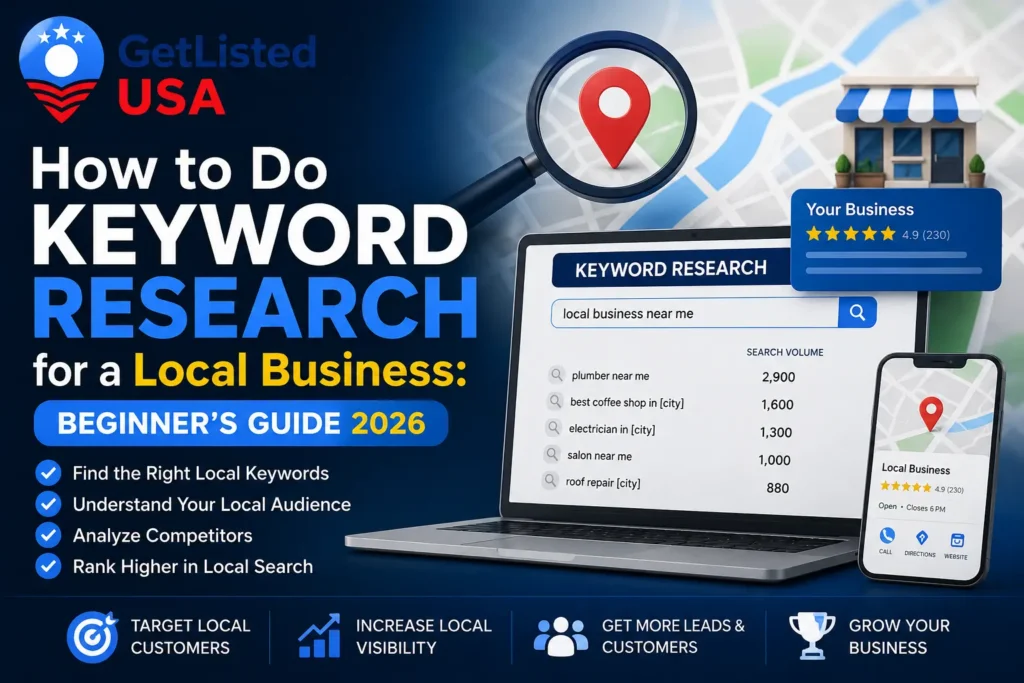
To do keyword research for a local business, start with the service + city formula: combine what you do with where you do it ‘plumber Houston’ or ‘Italian restaurant Chicago.’ Then use Google Autocomplete, People Also Ask, and free tools like Google Keyword Planner to find variations with real search volume. Focus on keywords with local intent containing city names, neighborhood names, or ‘near me’ and target lower-competition long-tail variations first to build rankings quickly.
Keyword research sounds technical. For local businesses, it’s actually one of the most intuitive marketing activities available because your keywords are literally what your customers type into Google when they want what you sell, in the city where you sell it. Most local businesses dramatically overthink it. The formulas are simple. The tools are free. And the opportunities are hiding in plain sight.
What Makes a Keyword ‘Local’ in 2026
A local keyword is any search query indicating the user wants results near a specific location. Local keywords include explicit location modifiers like city names or ZIP codes, implicit location intent like ‘near me’ and ‘open now,’ and service queries Google interprets as locally-intended even without location words ‘pizza delivery’ and ’emergency locksmith’ trigger local results automatically. According to Safari Digital (2026), 46% of all Google searches have local intent far more queries are ‘local’ than contain explicit location words.
From experience: A Seattle coffee shop owner was trying to rank for ‘coffee shop Seattle’ dominated by major chains. By shifting focus to ‘specialty coffee Capitol Hill Seattle,’ ‘pour-over coffee near Pike Place,’ and ‘third wave coffee Belltown,’ they found keywords with real search volume and significantly lower competition. Within four months they ranked top 3 for all three neighborhood-specific keywords, driving consistent new customer traffic from nearby office workers.
The Service + Location Formula
AEO Quick Answer: The service + location formula is the foundation of local keyword research. Combine your primary service with your city: ‘plumber Houston.’ Then expand to neighborhoods: ‘plumber Katy TX.’ Then add qualifiers: ’emergency plumber Houston,’ ‘affordable hair salon South Beach.’ Each variation targets a different searcher with different intent and different competition levels.
- Primary service + city: ‘plumber Houston’ high volume, high competition
- Primary service + neighborhood: ‘plumber Katy TX’ medium volume, lower competition
- Qualified service + city: ’emergency plumber Houston’ medium volume, high intent
- Service + city + qualifier: ‘affordable plumber Houston TX’ lower volume, very high conversion intent
Free Tools for Local Keyword Research in 2026
The best free tools for local keyword research are: Google Keyword Planner (volume and competition data), Google Autocomplete (real search suggestions from actual users), Google’s People Also Ask boxes (FAQ-style keywords perfect for content), Google Search Console (shows keywords your site already appears for find quick wins in positions 5-20), and Semrush’s free tier (limited daily searches but valuable for competitor keyword analysis).
Google Autocomplete: Start Here
Type your primary service into Google and don’t press enter. Watch the suggestions. Those autocomplete results are the most popular searches related to your query real data from real users. For ‘plumber Houston,’ you might see ‘plumber Houston emergency’ or ‘plumber Houston 24 hour.’ Each suggestion is a keyword worth targeting.
People Also Ask
Search your primary keyword and scroll to the ‘People Also Ask’ section. These questions are perfect targets for FAQ content on your website and directory listing descriptions. ‘How much does a plumber cost in Houston?’ is a keyword-optimized FAQ question hiding in plain sight.
Google Search Console
If your website exists and is verified in Search Console, this is your most valuable free keyword tool. It shows which queries are generating impressions and crucially, which are in positions 5-20 with decent impressions. Those are your quick wins.
Building Your Local Keyword Map
A local keyword map organizes target keywords by page each page targets a specific keyword cluster. Homepage targets primary service + city. Each service page targets a specific service keyword. Each location page targets that location + service. Your blog targets informational keywords. Mapping one primary keyword and 3-5 secondary keywords to each page prevents keyword cannibalization and gives Google a clear signal about what each page is about.
- Homepage: primary service + city (‘Plumbing Services Houston TX’)
- Service pages: specific service + city (‘Emergency Plumber Houston’)
- Location pages: service + neighborhood (‘Plumber Katy TX’)
- Blog posts: informational keywords (‘how much does a plumber cost in Houston’)
Your GetListedUSA listing description is itself keyword real estate. Include your primary service keyword, your city, and secondary keywords naturally in that 150-300 word description on the GetListedUSA directory. Our complete local SEO guide covers the full on-site strategy. BrightLocal’s keyword research resources and SBA.gov offer additional guidance.
Frequently Asked Questions
Q: How many keywords should a local business target?
A: Focus on 1 primary keyword per page, supported by 3-5 secondary keywords. A typical local business website might have 10-20 pages, giving you 10-20 primary keyword targets.
Q: Are ‘near me’ keywords worth targeting?
A: You can’t directly optimize for ‘near me’ with city-specific content Google resolves it using the searcher’s device location. Optimize your GBP and citations; the ‘near me’ rankings follow.
Q: Should I focus on local keywords for my directory listings or my website?
A: Both. Your website targets keywords through dedicated pages. Directory listings target keywords through your description and category. Both contribute to your overall local keyword footprint.
Q: What is keyword cannibalization?
A: When multiple pages on your website target the same keyword, causing Google to rank the wrong page. Avoid it by mapping one unique primary keyword to each page.
Q: How often should a local business update its keyword strategy?
A: Review quarterly using Google Search Console. Look for new keywords generating impressions, and identify positions 5-20 where a small push can break into the top 3.
Start Building Your Local Keyword Strategy Today
Start with Google Autocomplete for your primary service and city. Map keywords to pages. Optimize your GetListedUSA listing description with primary and secondary keywords naturally included. Then build your content strategy using our local SEO guide.