
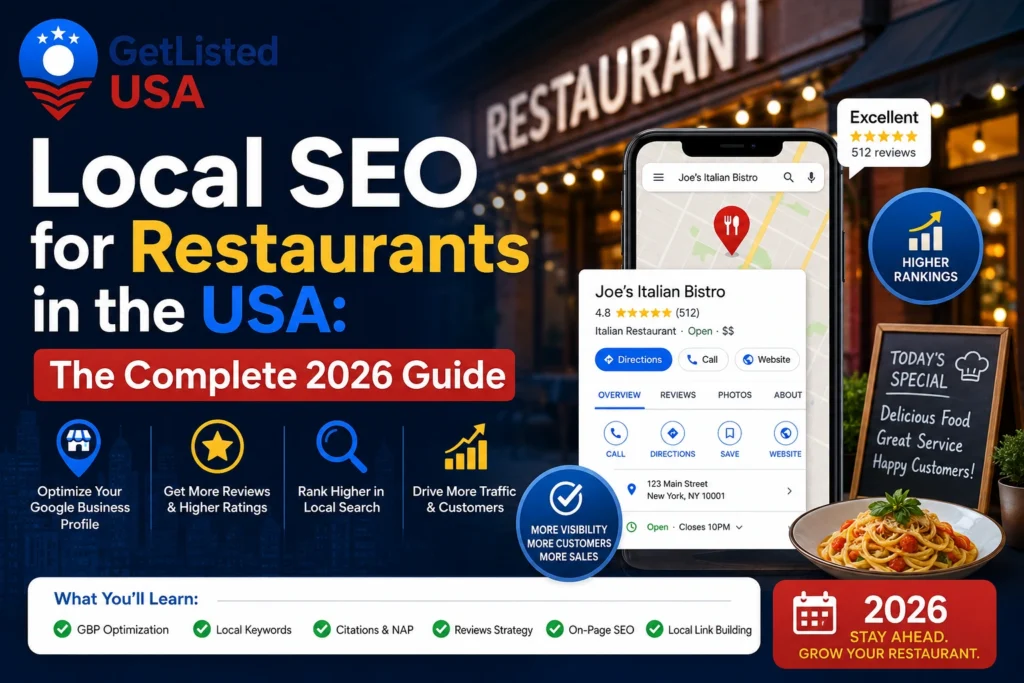
Local SEO for restaurants in 2026 starts with a fully optimized Google Business Profile using the most specific cuisine category, ‘Italian Restaurant,’ not ‘Restaurant.’ Add your complete menu to GBP; maintain consistent NAP citations across Yelp, TripAdvisor, GetListedUSA, and other trusted directories; generate steady reviews with consistent owner responses; and add restaurant schema markup. Restaurants in the local 3-pack capture 80% of clicks for food searches.
Over 80% of diners search online before choosing where to eat, and most searches happen within an hour of the meal. ‘Italian restaurant near me. ”Best brunch in Chicago. ”Sushi open now.’ These are purchase decisions happening in real time on mobile phones. The restaurant appearing in Google’s local 3-pack gets the reservation. The one invisible in local search gets nothing.
I’ve helped restaurant owners across the US navigate local SEO, from a taco truck in Los Angeles that tripled weekly revenue after getting its Google Business Profile right to a fine dining establishment in New York whose Michelin rating wasn’t enough to overcome invisible directory listings. The technical factors are straightforward. Execution and consistency are everything.
Why Local SEO Is Different for Restaurants
Restaurant local SEO is different because decisions are made in seconds, are heavily influenced by photos and reviews, are highly time-sensitive (open now or tonight), and are driven by visual appeal before any other factor. Research from LocalMighty (2026) shows restaurant decisions are emotional and immediate; a diner searching ‘best sushi near me’ will choose within seconds based on star rating, photo quality, distance, and whether you’re currently open. Google’s algorithm reflects this: restaurant rankings weight recency and review velocity more heavily than most categories.
From experience: A Houston Tex-Mex restaurant had a 4.8-star average and 340 reviews; genuinely one of the best-reviewed in their neighborhood. But they ranked 6th in the local pack because their GBP primary category was ‘Mexican Restaurant’ when ‘Tex-Mex Restaurant’ was available as a specific category. One category change moved them from position 6 to position 2 within four weeks. Category specificity was everything.
Google Business Profile: The Foundation of Restaurant Local SEO
Your Google Business Profile is the most important asset for restaurant local SEO. Eight of the top ten local pack ranking signals come directly from your GBP (Whitespark 2026). The most critical GBP elements for restaurants: the most specific cuisine category as primary, a complete menu added to GBP, high-quality food and interior photos updated monthly, accurate hours including holiday variations, booking integration with your reservation system, and Google Posts published weekly with specials and new menu items.
- Primary category be specific: ‘Italian Restaurant’ beats ‘Restaurant.’ ‘Neapolitan Pizza’ beats ‘Italian Restaurant’ if that’s your specialty
- Menu: Add your complete menu directly to GBP. AI systems reference structured menus when recommending restaurants
- Businesses with photos receive 42% more direction requests (Google). For restaurants, food photos are most important. Update monthly
- Booking integration connect OpenTable, Resy, or Yelp Reservations directly to GBP for one-tap booking
- Google Posts publish weekly with specials, events, new menu items
Restaurant Citations: Building Your Local SEO Foundation
Restaurant citations are mentions of your restaurant’s NAP across directories, review sites, and food discovery platforms. For restaurants, the most important citation sources are Google Business Profile, Yelp, TripAdvisor, Facebook, Apple Maps, Bing Places, GetListedUSA, OpenTable, Zomato, and Foursquare. NAP consistency across all platforms is non-negotiable inconsistency suppresses rankings by 23-35% (Digital Vidya, 2026).
From experience: A Dallas BBQ restaurant had a Yelp listing showing a phone number from before they changed ownership two years earlier. Customers were calling the wrong number, getting no answer, and moving on to a competitor. After fixing their NAP across 19 directories, their call volume from directory listings increased 40%. The food was always great. The inconsistent data was killing them.
- Yelp DA 93, high consumer intent for restaurant searches
- TripAdvisor DA 93, powerful for tourist and destination dining
- Zomato food-specific directory with strong local search presence
- GetListedUSA free USA directory covering all 50 states and all food categories
For the complete listing of restaurant-relevant directories, see our guide to business listing sites in the USA. Check BrightLocal’s 2026 local SEO statistics for restaurant-specific citation data.
Restaurant Review Strategy
Reviews account for approximately 15-17% of local pack ranking factors for restaurants in 2026. Recency and velocity matter more than total volume. A restaurant generating 5 new reviews per week consistently outranks one with 500 old reviews. Responding to every review within 48 hours is both an SEO signal and a conversion driver. Restaurants with consistent owner responses convert searchers at significantly higher rates than those that ignore reviews.
- Train front-of-house staff to mention reviews naturally after positive dining experiences
- Add a QR code to receipts linking directly to your Google review page
- Respond to every review positive and negative, within 48 hours
- Aim for 5-10 new reviews per month minimum in competitive US markets
Restaurant Schema Markup
Restaurant schema markup is structured data added to your website that tells Google and AI systems exactly what type of restaurant you are, your hours, cuisine type, price range, and menu. Adding LocalBusiness and Restaurant schema in JSON-LD format helps earn rich snippets, improves voice search visibility, and feeds AI tools like Google’s Gemini and ChatGPT Search that generate restaurant recommendations for 45% of consumers (BrightLocal, 2026).
In 2026, Google’s Ask Maps feature, launched March 12, 2026, uses Gemini AI to answer conversational queries like ‘quiet Italian restaurant for a business dinner with outdoor seating.’ ‘ Restaurants with complete, structured schema data and complete GBP information are far more likely to be surfaced. For resources, visit SBA.gov’s food service industry resources and our local SEO guide.
Frequently Asked Questions
Q: What is the most important thing a restaurant can do for local SEO in 2026?
A: Optimize your Google Business Profile with the most specific cuisine category available, complete your menu directly in GBP, and add high-quality food photos. 8 of the top 10 local pack ranking signals come from your GBP (Whitespark 2026).
Q: How many reviews does a restaurant need to rank in the Google local 3-pack?
A: In smaller cities, 20-30 reviews may be sufficient. In competitive urban markets, 100+ reviews with consistent velocity (5-10 per month) is typical for top-3 positions. Review recency matters as much as volume.
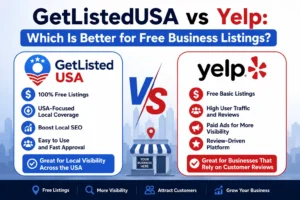
Q: Should my restaurant be listed on GetListedUSA and Yelp and TripAdvisor?
A: Yes to all three. List your restaurant on GetListedUSA it’s free and takes under 10 minutes. Citation diversity across many trusted platforms is how Google builds confidence in your restaurant’s legitimacy.
Q: Does having a PDF menu hurt my restaurant’s local SEO?
A: Yes. Google has very limited ability to read PDF content. Convert your menu to an HTML page to make it fully crawlable and searchable for specific dish names and dietary terms.
Q: How does AI search affect restaurant discovery in 2026?
A: Significantly. Google’s Ask Maps and ChatGPT Search recommend local restaurants by pulling from GBP data, structured citations, reviews, and schema markup. Complete presence on the GetListedUSA directory and other platforms improves your AI-powered search visibility.
Start Winning Restaurant Local Search Today
List your restaurant for free on GetListedUSA, claim your Yelp and TripAdvisor listings, add your menu to GBP, and implement your review strategy. Follow the complete framework in our local SEO guide.