
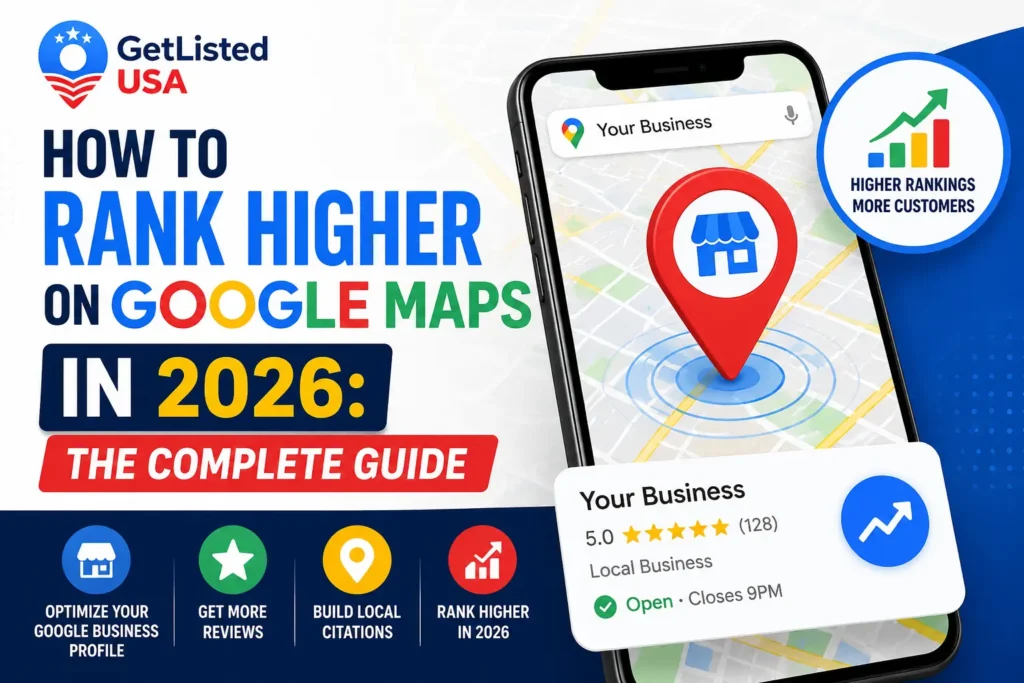
To rank higher on Google Maps in 2026, optimize your Google Business Profile completely starting with the correct primary category. Then build consistent NAP citations across 30+ trusted directories, generate a steady flow of authentic reviews, ensure your website is locally optimized, and add structured data markup. According to the Whitespark 2026 report, 8 of the top 10 local pack ranking signals come directly from your Google Business Profile. Fix that first.
Every day, millions of Americans pull out their phone and search for a local business a plumber, a restaurant, a dentist, a salon. The businesses that appear in Google’s local 3-pack receive 40–50% of all clicks for those searches. Position 1 in the local pack captures roughly 34% CTR. The businesses below the 3-pack get scraps. This guide is about getting into that top three.
I’ve spent six years helping businesses across New York, Los Angeles, Houston, Chicago, and Phoenix climb Google Maps rankings. What I can tell you with certainty is this: there are no shortcuts, no hacks, and no tricks that hold up over time. But there is a clear, methodical process that consistently moves businesses up the local pack and it’s more straightforward than most business owners realize.
According to the Whitespark 2026 Local Search Ranking Factors report compiled from 47 global SEO experts 8 of the top 10 local pack ranking signals originate from your Google Business Profile. That single fact should tell you where to focus your energy first.
How Google Decides Who Ranks on Google Maps in 2026
Google Maps rankings are determined by three core factors: Relevance (how closely your profile matches the search query), Distance (how close your business is to the searcher), and Prominence (how well-known and trusted Google considers your business to be). In 2026, Gemini AI integration has made data richness a fourth critical factor Google’s AI reads your profile, reviews, and directory data to answer conversational local queries. You can’t control distance, but relevance and prominence are fully within your control.
Google has been transparent about its three-factor framework for local rankings since 2018, and in 2026 those three factors still govern the local pack. What has changed is the weight given to each signal and the addition of AI-driven interpretation.
Relevance measures how well your profile matches what the searcher is looking for. Your primary GBP category is the single most important relevance signal it tells Google what type of business you are and determines which searches you’re eligible to appear for. Choose the most specific, accurate primary category available. Add up to 10 secondary categories for services you genuinely offer.
Distance measures how close your business is to the person searching, or the location they’ve specified in their query. Since Google’s 2021 Vicinity update, proximity has become a heavier-weighted signal. A business closer to the searcher will often outrank a better-optimized competitor that’s farther away. You can’t change where your business is but you can maximize your other signals to partially offset distance disadvantage.
Prominence is Google’s measure of how well-established and trusted your business appears across the web. It’s built from reviews, citations, backlinks, GBP completeness, and behavioral signals clicks, calls, direction requests from your listing. This is where most of your optimization work lives.
From experience: A Chicago dental practice I worked with was ranking 9th in the local pack despite having an excellent location and strong reviews. Their problem was a nearly empty GBP no photos, no services listed, no business description, minimal categories. After a complete GBP overhaul over 30 days, they moved to position 4 without building a single new backlink. Relevance signals were the entire gap.
Step 1: Google Business Profile The Foundation of Everything
Your Google Business Profile is the most important single asset for Google Maps ranking. The Whitespark 2026 report confirms 8 of the top 10 local pack signals come from GBP. Complete every section: primary category, secondary categories, business description with keywords, hours, services, products, attributes, and photos. Verify your listing unverified profiles cannot rank in the local pack. An incomplete GBP is the most common reason good businesses fail to appear in local search.
Go to business.google.com and audit your profile against this checklist:
- Primary category the single most important ranking signal. Be specific: “Italian Restaurant” outperforms “Restaurant.” “Emergency Plumber” outperforms “Plumber.”
- Secondary categories add every relevant service you genuinely offer, up to 10 categories
- Business description 750 characters, include your primary keyword and city naturally in the first sentence
- Hours eep them current including holidays and special hours
- Services and products list every service with descriptions and prices where applicable
- Attributes “wheelchair accessible,” “women-led,” “veteran-owned” these filter search results
- Photos minimum 10 photos: exterior, interior, team, products/work. Businesses with photos receive 42% more direction requests (Google)
- Q&A section add your own questions and answers for common customer queries
- Posts publish updates, offers, and events regularly. Active profiles rank higher than dormant ones
According to a Geolid analysis of over 30,000 listings tracked hourly, average rating, review freshness, response rate, and listing completeness explained most of the top-3 position variation in competitive markets.
Step 2: Build Consistent NAP Citations Across 30+ Directories
NAP citations are mentions of your business Name, Address, and Phone number across the web. Google cross-references citation data from dozens of sources to verify your business. The Whitespark 2026 report confirms citation signals account for 7% of local pack ranking factors. NAP consistency improvements deliver an average 23% local ranking improvement. Build citations on high-authority platforms first Google Business Profile, Yelp, Apple Maps, Bing Places, GetListedUSA then expand to 30–50 total quality listings.
Citations work like identity verification for Google. Every time your business NAP appears consistently on a trusted platform, Google gains more confidence that your business is real, located where you say, and worth ranking for local searches.
Start with the highest-authority platforms and work down:
- Google Business Profile your most powerful citation and your primary ranking asset
- Apple Business Connect feeds Siri, Apple Maps, and Apple Intelligence
- Bing Places covers 30% of US desktop search
- Yelp DA 93, strong trust signal
- Facebook Business DA 96, local discovery and social proof
- GetListedUSA free USA-focused directory, all 50 states
- Foursquare feeds dozens of downstream apps and platforms
- Better Business Bureau critical trust signal for service businesses
For the complete list of US directories worth submitting to, see our business listing sites USA guide. For citation audit tools, BrightLocal’s resources include free and paid citation scanning tools.
Step 3: Reviews The Highest-Leverage Prominence Signal
Reviews account for approximately 15% of local pack ranking according to Google’s ranking factors. Google evaluates review quantity, star rating, recency, keyword mentions within reviews, reviewer credibility, and whether the owner responds. Businesses with 100+ reviews and consistent owner responses consistently outrank those with similar counts but no replies (Yext, 2026). Aim for a minimum of 5–8 new reviews per month to maintain ranking momentum.
Reviews are both a ranking signal and a conversion driver. When Google sees consistent, recent, keyword-rich reviews from credible accounts with professional owner responses it treats your business as active, trusted, and worth showing to searchers.
A practical review strategy for 2026:
- Ask every satisfied customer for a review in person, by text, by email, on receipt
- Make it effortless: send a direct Google review link (find it in your GBP dashboard)
- Respond to every review within 48 hours thank positive reviewers, address negatives professionally
- Never incentivize reviews Google’s terms prohibit it and the reviews will be removed
- Aim for velocity: 5–8 new reviews per month is more valuable than 50 reviews in one week
From experience: A Phoenix HVAC company I helped went from 12 reviews to 67 reviews over six months using nothing but a post-job text message asking for feedback. Their local pack position improved from 6 to 2 during that period with no other changes to their digital presence. Reviews were the entire difference.
Step 4: Website Optimization for Local Search
Your website supports your Google Maps ranking through on-page signals that confirm your business category, location, and services. Key website factors include a consistent NAP in the footer on every page, location-specific title tags and H1 headings, local service pages targeting city and neighborhood keywords, LocalBusiness schema markup in JSON-LD format, and a fast mobile experience. Google’s algorithm reads your website alongside your GBP to determine relevance and prominence.
Your website and your GBP work as a system Google cross-references them to verify consistency and build its understanding of your business. Key on-site optimizations for local ranking:
- Include your NAP in the footer of every page identical to your GBP listing
- Create location-specific landing pages for each city or neighborhood you serve
- Use LocalBusiness schema markup (JSON-LD) on your homepage and contact page
- Write title tags that include your primary keyword and city: “Plumber Houston TX | Garcia Plumbing”
- Ensure your site loads in under 3 seconds on mobile 60% of local searches happen on mobile (Webnyxt, 2026)
- Add a Google Maps embed on your contact page
Step 5: Behavioral Signals Clicks, Calls, and Directions
Google Maps tracks how users interact with your listing clicks to your website, phone calls initiated from the listing, direction requests, and time spent viewing your profile. High engagement signals tell Google your listing is relevant and useful, which correlates with higher rankings. Optimize your photos, description, and attributes to maximize click-through rate. Active profiles with regular posts generate more engagement than static, unmaintained ones.
Behavioral signals are often overlooked but increasingly important. According to Scrap.io’s 2026 analysis, listings that attract more engagement measured by calls, direction requests, website clicks, and photo views outperform those with similar citation profiles and review counts but lower engagement. Improving your listing’s click-through rate is a ranking signal.
Step 6: AI Search and Google Maps in 2026
In 2026, Google’s Gemini AI now powers Ask Maps and AI-assisted local recommendations. Gemini reads your entire GBP categories, services, attributes, photos, description, reviews and synthesizes it to answer conversational queries like “best plumber near me open now.” Unstructured citations (brand mentions in blogs, news articles, and forums) are the 4th most important AI visibility factor per Whitespark 2026. A rich, complete, consistent online presence across directories and the web makes you more visible to AI-powered search.
The Whitespark 2026 report flagged something important: unstructured citations your business name appearing in blog posts, news articles, Reddit threads, local forums are now the 4th most important factor for AI search visibility. This is genuinely new territory. PR, community involvement, guest articles, and local blog features all directly feed AI visibility now.
For AI-powered tools like ChatGPT Search, which 45% of consumers now use for local recommendations (BrightLocal, 2026), directory data is a primary input. The GetListedUSA directory contributes structured business data that AI systems use to identify and recommend local businesses. The more complete and consistent your directory presence, the more visible you become across both traditional Google Maps and AI-powered search.
Frequently Asked Questions
Q: How long does it take to rank higher on Google Maps?
A: According to Safari Digital, the average local SEO campaign takes 4.76 months to show clear results. Basic GBP optimizations can produce movement within 2–4 weeks. Building a substantial review base and citation profile typically takes 3–6 months in competitive markets. New businesses in lower-competition areas may see local pack appearances within weeks.
Q: Can I pay Google to rank higher on Google Maps?
A: No. Organic Google Maps rankings are algorithm-driven they cannot be purchased. Google does offer Local Services Ads and Google Ads that appear near Maps results, but these are paid placements separate from organic local pack rankings. The local pack itself is determined by relevance, distance, and prominence signals.
Q: Does my business need a physical address to rank on Google Maps?
A: For maximum local pack ranking, a verified physical address in your target market is significantly more powerful than a service area listing. That said, service-area businesses (plumbers, electricians, cleaners) can still rank in Google Maps by setting a service area in their GBP and building strong relevance and prominence signals.
Q: How many reviews do I need to rank in the Google Maps local pack?
A: There’s no magic minimum. In lower-competition markets, 10–20 reviews can be enough to rank. In competitive urban markets like New York or Los Angeles, 50–100+ reviews with consistent velocity is more typical for top-3 positions. Review recency and velocity matter as much as total count 5 new reviews per month is more valuable than 100 reviews that stopped two years ago.
Q: My competitor has fewer reviews than me but ranks higher. Why?
A: Multiple factors contribute simultaneously. They may have a more complete GBP, a stronger website, better category selection, more consistent citations, higher behavioral engagement, or a proximity advantage. The Whitespark 2026 report identifies 8 major signal categories reviews are just one. Audit all eight before concluding why a competitor outranks you.
Start Ranking Higher on Google Maps Today
The path to ranking higher on Google Maps is clear: complete your GBP, build consistent citations, generate authentic reviews, optimize your website, and let behavioral signals compound over time. None of these steps are complicated. All of them require consistency.
Start with your Google Business Profile today. Then build your citation foundation list your business for free on GetListedUSA, claim your Bing Places listing, and work through the platforms in our complete local SEO guide. The businesses at the top of Google Maps in your market started this process months ago. Today is the best day to start yours.