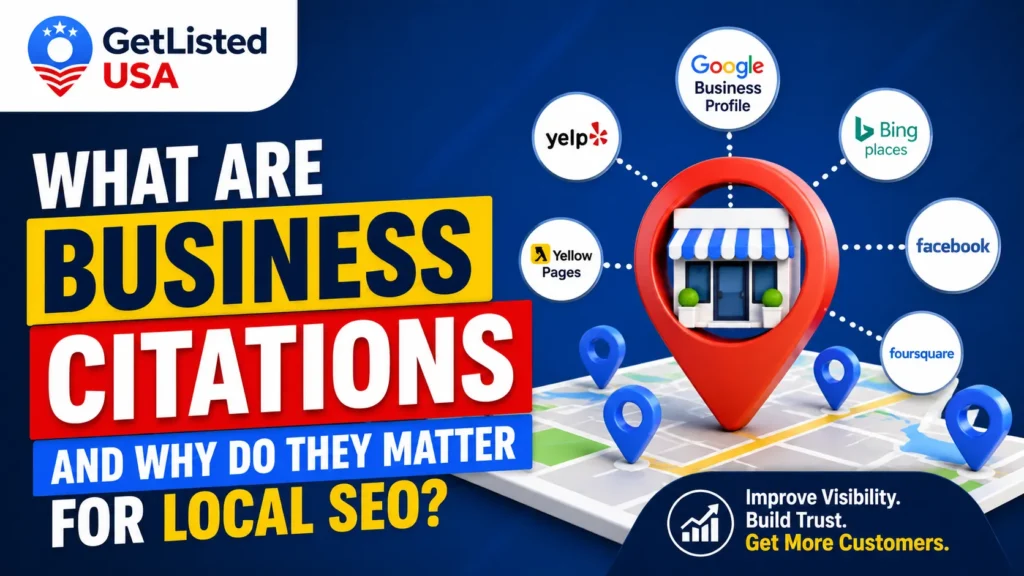
A business citation is any online mention of your business Name, Address, and Phone number (NAP). Citations appear on directories, review sites, social platforms, and local websites. Search engines use them to verify your business is real, legitimate, and located where you say it is. Consistent citations across trusted platforms are a confirmed local SEO ranking factor that directly improves your Google Maps and local pack visibility.
Here is a question I get from almost every small business owner I work with: “I set up my Google Business Profile and have a website, why am I still not ranking locally?” Nine times out of ten, the answer comes down to citations. Or more precisely, the lack of them, or worse, the mess of inconsistent ones scattered across the web without the owner even knowing.
Business citations are one of the most misunderstood concepts in local SEO. They sound technical. They sound optional. They are neither. According to the Whitespark 2026 Local Search Ranking Factors report compiled from 47 global SEO experts, citation signals account for 7% of total local ranking influence in the Local Pack, and 13% for AI search visibility. That might not sound huge, but in a competitive local market, 7% is often the difference between page one and page two.
This guide explains exactly what business citations are, why they still matter enormously in 2026, the difference between structured and unstructured citations, how to build them correctly, and the mistakes that silently destroy your local rankings. Whether you run a restaurant in Chicago, a plumbing company in Houston, or a salon in Los Angeles, this is foundational knowledge every US small business owner needs.
What Are Business Citations? The Clear Definition
A business citation is any online reference to your business that includes your Name, Address, and Phone number, commonly called NAP. Citations appear on directories like Yelp and Yellow Pages, review sites, social platforms, local blogs, and news websites. Search engines use citations to confirm your business is real, active, and located where you claim. The more consistent and accurate your citations are across the web, the stronger your local search trust signal becomes.
Think of a citation the way you would think of a reference on a job application. When a dozen reputable sources all confirm the same information about you, your name, your location, your contact details, the person reading those references develops confidence in your credibility. Citations work identically for Google.
Every time your business NAP appears correctly on a trusted website, whether that’s Yelp, a local chamber of commerce page, GetListedUSA, or a neighborhood blog, Google registers it as one more confirmation that your business is legitimate. GetListedUSA directory is one of the free USA citation sources worth claiming, especially for businesses serving customers across multiple states.
In 2026, the strongest citations go beyond basic NAP. SEO professionals now refer to complete citations as NAPW Name, Address, Phone, and Website. Many high-authority directories also capture business hours, categories, photos, and descriptions. The more complete each citation, the stronger the trust signal it sends.
From experience: I audited a Chicago dental practice that had been struggling to rank for “dentist near me” for two years despite a beautiful website and an active Google Business Profile. When I ran a citation audit using BrightLocal, I found 47 directory listings. 31 of which had a different phone number from when the practice had changed offices three years earlier. After correcting those citations for over 90 days, they moved from position 8 to position 3 in the local pack. Citations were the only thing we changed.
Structured vs Unstructured Citations: What’s the Difference?
Structured citations appear on business directories and listing sites in a consistent, formatted way, Yelp, Bing Places, Yellow Pages, and GetListedUSA are examples. Unstructured citations are informal mentions of your business on blogs, news sites, social posts, or review articles that include your NAP without a standard directory format. Both types contribute to local SEO authority, but in different ways. Structured citations build your foundational trust layer. Unstructured citations build brand prominence and natural web presence.
Structured Citations
These are the listings you create deliberately on directories and business platforms. They follow a fixed format: business name, address, phone, website, hours, category, description. Examples include:
- Google Business Profile — the most powerful citation you can have
- Yelp, Yellow Pages, Bing Places, Apple Maps — core general directories
- GetListedUSA — free USA business directory, all 50 states
- BBB, Foursquare, Manta — trust and authority platforms
- Industry-specific directories — Healthgrades for healthcare, Houzz for home services, Avvo for legal, Zocdoc for medical
Structured citations are the foundation. Build these first, complete every field, and verify the NAP is identical across all of them before moving on.
Unstructured Citations
These occur naturally, or through outreach when your business is mentioned on websites that aren’t directories. A local news article covering your restaurant opening. A blogger recommending your salon. A community Facebook group post mentioning your plumbing company by name and phone number. These are unstructured citations, and in 2026, they are increasingly powerful because they signal genuine community presence and brand prominence rather than manufactured submissions.
According to Citation Building Group (2026), a citation profile dominated entirely by structured directory listings can look unnatural to Google’s current algorithm. A healthy mix of both types of structured foundations plus earned unstructured mentions, builds the most credible local presence.
Why Business Citations Still Matter in 2026
Business citations matter in 2026 because they are a confirmed Google local ranking factor, they feed AI search tools like ChatGPT and Google’s AI Overviews with accurate business data, and they build the prominence signal Google uses to determine which businesses deserve top local rankings. NAP consistency across citations also directly improves trust, 73% of consumers lose trust when they find inconsistent business information online, according to Business Wire.
Some SEO voices claim citations are dying. The data says otherwise. Here is what the research actually shows in 2026:
- Citation signals account for 7% of Local Pack ranking factors and 13% of AI search visibility factors, Whitespark Local Search Ranking Factors 2026
- NAP consistency across platforms improves local rankings by an average of 23% — Moz / BrightLocal
- Three of the top five AI visibility factors are citation-related, according to Advice Local’s analysis of the Whitespark 2026 report
- 45% of consumers now use AI tools like ChatGPT for local business recommendations, BrightLocal 2026
- Businesses with 10 accurate, high-authority citations consistently outrank competitors with 200 low-quality, inconsistent ones — Citation Building Group 2026
That last point is worth dwelling on. Volume is not the goal. Accuracy and consistency are the goals. Ten perfectly maintained citations on high-authority platforms outperform two hundred sloppy submissions on spam directories every single time.
There is also an AI angle that makes citations more important in 2026 than they were in 2020. When someone asks ChatGPT or Google’s AI Overview “what’s the best plumber near me in Dallas,” these AI systems pull from directory data, structured citations, and knowledge graph information to generate their answers. If your business has clean, consistent, complete citations on trusted platforms, you are far more likely to be recommended. If your citations are a mess, you are invisible to AI-powered search — which now influences 45% of local buying decisions.
How to Build Business Citations the Right Way
Build business citations correctly by first creating a Master NAP Document with your exact business name, address, phone, website, hours, and description. Then claim and complete your Google Business Profile, followed by core data aggregators, then general directories, then industry-specific and local directories. Fix inconsistencies before adding new listings. Complete every field on every platform. Monitor citations quarterly for accuracy.
Step 1 — Create Your Master NAP Document
Before touching a single directory, create a reference document with your exact NAP information in the format you will use everywhere, forever. This includes:
- Exact business name (as it appears legally or as your trading name)
- Full address in one consistent format
- Primary phone number in one consistent format
- Website URL
- Business category (primary and secondary)
- Business hours, including holidays
- 150–300-word business description with your primary keyword included naturally
- 3–5 professional photos
Step 2 — Start With Core Data Aggregators
Data aggregators feed business information to hundreds of downstream directories automatically. Getting listed correctly on these four sources is one of the highest-leverage citation moves you can make:
- Data Axle (formerly InfoUSA) — feeds hundreds of directories and apps
- Neustar Localeze — feeds navigation systems and voice search
- Foursquare — feeds dozens of apps including Apple Maps
- GPS data providers — in-vehicle navigation systems
Step 3 — Build the Core Eight Directories
These are the highest-priority structured citations for any US business. Complete every field, not just the basics:
- Google Business Profile (business.google.com)
- Apple Business Connect (businessconnect.apple.com)
- Bing Places (bingplaces.com)
- Yelp (biz.yelp.com)
- Facebook Business Page
- GetListedUSA — free, USA-focused, all 50 states
- Better Business Bureau (bbb.org)
- Yellow Pages (yp.com)
Step 4 — Add Industry-Specific Citations
These carry extra relevance weight because they signal to Google not just that your business exists, but that it belongs to a specific category and is recognized within your industry:
- Restaurants: TripAdvisor, OpenTable, Zomato, Grubhub
- Home services: Angi, HomeAdvisor, Houzz, Thumbtack
- Healthcare: Healthgrades, Zocdoc, WebMD
- Legal: Avvo, FindLaw, Justia
- Beauty: StyleSeat, Vagaro, Booksy
- Real estate: Zillow, Realtor.com, Trulia
Also, read our complete local SEO guide for small businesses to understand how citations fit into your broader ranking strategy. For authoritative data on citation-building best practices, BrightLocal’s 2026 research hub is the industry standard reference.
How to Audit and Fix Existing Citations
Audit your existing citations by searching for your business name, phone number, and address across major directories. Use tools like BrightLocal, Whitespark, or Moz Local for a comprehensive scan. Fix inconsistencies starting with your highest-authority listings first. Remove or merge duplicate listings. Then update your address, phone, and hours wherever they appear incorrectly. Expect 30–90 days for corrections to reflect in local search rankings.
Most businesses discover, when they run their first citation audit, that they have a significant mess accumulated over years — old addresses, disconnected phone numbers, duplicate listings created by directories auto-generating profiles from other sources, and inconsistent business name formats.
From experience: A New York restaurant client came to me after moving locations. They had updated their Google Business Profile immediately but hadn’t touched any other directories. Eighteen months later, Yelp, Yellow Pages, Apple Maps, and 23 other sites still showed the old address. Customers were showing up at the wrong location, leaving furious reviews. Their local pack ranking had dropped from position 2 to position 9. We fixed every citation over 60 days and rankings recovered within 90 days.
The key audit tools to use:
- BrightLocal — comprehensive citation audit, finds inconsistencies across 100+ platforms
- Whitespark Citation Finder — identifies where competitors are listed that you are not
- Moz Local — scans major aggregators and directories for NAP consistency
- Manual search — Google your business name in quotes, then your phone number in quotes. Every result that contains incorrect information is a citation to fix.
Citation Mistakes That Kill Your Local Rankings
The most damaging citation mistakes are NAP inconsistency across platforms, creating duplicate listings, submitting to low-quality spam directories, leaving profiles incomplete, and never updating citations after a business move or phone number change. Each of these actively undermines your local SEO. Google treats inconsistency as a trust failure — and a business Google doesn’t trust, Google doesn’t rank.
- Inconsistent NAP format — “LLC” on one platform but not another, “St.” vs “Street,” “(512)” vs “512-” — these all count as inconsistencies to search engine algorithms
- Duplicate listings — multiple profiles for the same business on the same platform confuse Google and dilute your citation authority
- Low-quality directory submissions — mass-submitting to 500 spam directories is worse than doing nothing; it creates a toxic citation profile
- Incomplete profiles — a citation with only name and phone, but no address, website, or description, is a weak signal
- Outdated information — citations pointing to an old phone number or address after a business change actively mislead both customers and Google
- Ignoring industry-specific directories — these carry relevance signals that general directories cannot provide
Read Also: How to Find Local Businesses Near You | GetListedUSA
Frequently Asked Questions
Q: What is the difference between a citation and a backlink?
A: A citation is a mention of your business NAP, it may or may not include a link to your website. A backlink is specifically a hyperlink from another website to yours. Citations build local trust and prominence. Backlinks build domain authority. Both matter for local SEO, but they work in different ways. You can have a powerful citation with no backlink at all.
Q: How many citations does a US small business need?
A: There is no magic number, but most local SEO experts recommend a foundation of 30–50 accurate, high-authority citations before focusing on volume. Quality matters far more than quantity. 50 accurate citations on high-DA platforms will outperform 500 inconsistent ones on low-quality directories every time, according to Citation Building Group (2026).
Q: How long does it take for new citations to affect local rankings?
A: New citations typically take 30–90 days to be crawled, indexed, and reflected in local search rankings. Citation corrections — fixing wrong addresses or phone numbers often show ranking improvements within 30–60 days once the corrections propagate across platforms.
Q: Do citations help with AI search tools like ChatGPT?
A: Yes. According to the Whitespark 2026 Local Search Ranking Factors report, citation signals account for 13% of AI search visibility factors, the third most important category. When AI tools like ChatGPT Search or Google’s AI Overviews recommend local businesses, they pull from directory data and structured citations. Clean, consistent citations directly improve your AI search visibility.
Q: Should I use a citation-building service or do it myself?
A: For a new business, doing it yourself manually across the core 8–10 directories is manageable and gives you full control over your NAP accuracy. For businesses with existing inconsistent citations across dozens of platforms, a tool like BrightLocal or a professional citation service saves significant time and reduces errors.