If you run a local business in the USA and your phone is not ringing the way it should, there is a good chance your competitors are outranking you on Google. Not because they offer better services, but because they have better local SEO.
Local SEO is the process of optimizing your online presence so your business shows up when nearby customers search for what you offer. Think about searches like “plumber near me,” “best pizza in Chicago,” or “dentist open on Sunday.” Those results do not appear by accident. They are earned.
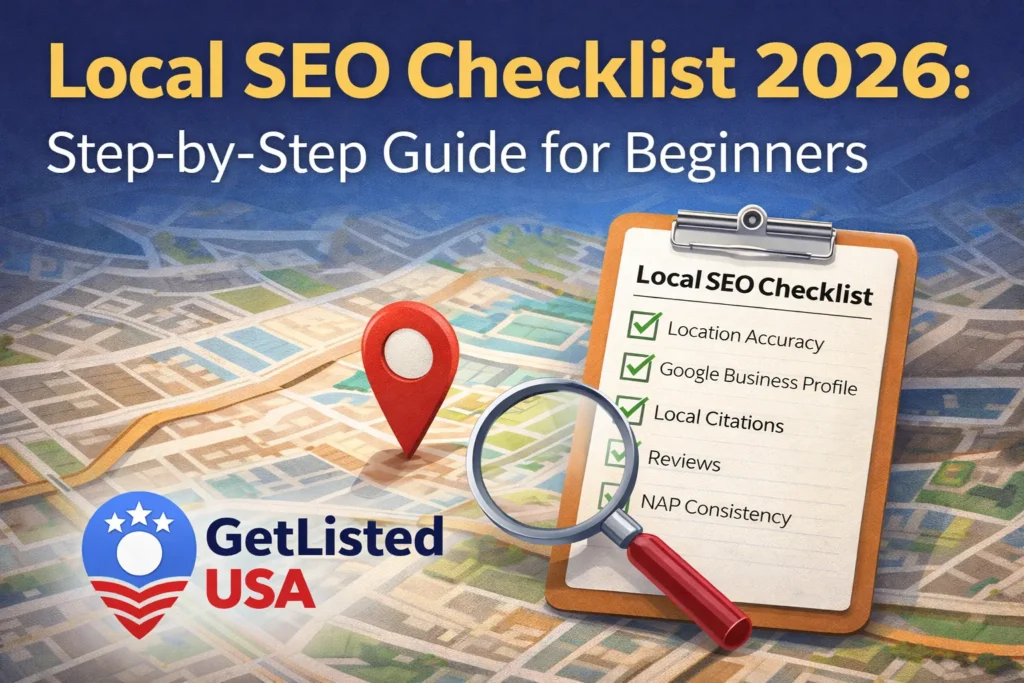
A local SEO checklist is a step-by-step list of actions that help your business rank higher in local Google search results and Google Maps. It covers Google Business Profile optimization, NAP consistency, local citations, on-page SEO, reviews, and link building. Following a comprehensive local SEO checklist helps small businesses attract nearby customers actively searching for their services.
What Is Local SEO and Why Does It Matter in 2026?
Local SEO is a branch of search engine optimization focused specifically on helping businesses appear in geographically relevant searches. When someone in Dallas searches “HVAC repair near me,” Google serves results based on proximity, relevance, and authority. Local SEO is how you make sure your business checks all three boxes.
In 2026, local search has become even more important because:
- Google AI Overviews now pull information from trusted local sources
- Voice search continues to grow, with queries like “Who is the best [service] near me?”
- Google Maps has become the first stop for millions of US consumers before making a purchase decision
- AI-powered answer engines like ChatGPT and Gemini recommend businesses they can verify online
Getting local SEO right is no longer optional for small businesses. It is the foundation of online visibility.
The Complete Local SEO Checklist for 2026
1. Google Business Profile Optimization
Your Google Business Profile (GBP) is the single most powerful local SEO asset you have. It directly controls what appears in Google Maps and the local pack (the top 3 results in local searches). Optimizing it completely takes less than an hour and delivers long-term results.
Your Google Business Profile is the first thing most local customers see before they even visit your website. Here is exactly what to do:
Claim and verify your listing
- Go to Google Business Profile and claim your listing
- Complete the verification process (postcard, phone, or video)
- Never skip verification as unverified profiles do not rank
Complete every single field
- Business name (use your real business name, no keyword stuffing)
- Address or service area
- Phone number
- Website URL
- Business hours, including holidays
- Business category (primary + additional categories)
- Business description with your primary keyword naturally included
Add high-quality photos
- Upload your logo and cover photo
- Add interior, exterior, team, and product photos
- Businesses with photos receive significantly more clicks than those without
Use Google Posts regularly
- Share updates, offers, and events at least twice per month
- Posts keep your profile active and signal relevance to Google
Enable messaging and Q&A
- Answer all customer questions promptly
- Seed the Q&A section with your own commonly asked questions and answers
2. NAP Consistency Across the Web
NAP stands for Name, Address, and Phone number. Google cross-checks your business information across hundreds of websites. If your NAP details are inconsistent, Google loses trust in your business and your rankings drop. NAP consistency is a foundational step that many beginners overlook.
Your business name, address, and phone number must be identical everywhere they appear online. This means:
- The same abbreviations (St. vs Street, Ave vs Avenue)
- The same phone number format
- The same business name spelling
Where to check and fix NAP consistency:
- Your own website
- Google Business Profile
- Yelp, Facebook, Apple Maps, Bing Places
- Business directories like GetListedUSA
- Industry-specific directories
A free listing on GetListedUSA is one of the fastest ways to build a consistent, trusted citation for your US-based business. It takes minutes to set up and covers all 50 states.
3. Local Citations and Directory Listings
A local citation is any online mention of your business’s NAP information. Citations from trusted directories signal to Google that your business is legitimate and established. The more consistent citations you have across authoritative platforms, the stronger your local authority becomes.
Citations are to local SEO what backlinks are to traditional SEO. They build trust.
Priority citation sources for US businesses:
- Google Business Profile
- Yelp
- Facebook Business Page
- Apple Maps
- Bing Places
- BBB (Better Business Bureau)
- GetListedUSA (free US business directory)
- Industry-specific directories (Houzz for home services, Healthgrades for medical, Avvo for legal, etc.)
Tips for building citations the right way:
- Always use the exact same NAP format
- Add a full business description to each listing
- Include your website URL on every citation
- Keep all listings updated if your address or phone number changes
4. On-Page SEO for Local Businesses
On-page local SEO means optimizing your website so Google understands who you are, what you do, and where you serve customers. This involves placing location-specific keywords in the right spots on your site, creating dedicated location pages, and making sure your NAP is visible on every page.
Your website is your digital storefront. Here is what to optimize:
Title tags and meta descriptions
- Include your primary service and location in the title tag (e.g., “Plumbing Services in Austin, TX”)
- Keep title tags under 60 characters
- Write compelling meta descriptions that include a call to action
Header tags (H1, H2, H3)
- Use H1 for your main page topic with location included
- Use H2 and H3 to organize content with relevant keyword variations
Location pages
- If you serve multiple cities, create a dedicated page for each one
- Each page should have unique content, not just a copy-paste with a different city name
Embed a Google Map
- Add an embedded Google Map on your contact page
- This reinforces your location signal to Google
NAP in website footer
- Display your full NAP in the footer of every page
- Make sure it matches your Google Business Profile exactly
Schema markup
- Add the LocalBusiness schema to your homepage and contact page
- This helps Google and AI search engines understand your business type and location
5. Online Reviews and Reputation Management
Online reviews are one of the top three ranking factors for local SEO. Google wants to recommend businesses that people trust. A steady stream of positive reviews signals that your business is active, reliable, and worth recommending. Asking every satisfied customer for a review is one of the highest-ROI tasks in local SEO.
Reviews do two things at once: they improve your rankings and they convert searchers into customers.
How to get more reviews:
- Ask every satisfied customer directly after their experience
- Send a follow-up email or text with a direct link to your Google review page
- Make the ask personal, not automated-sounding
- Never offer incentives for reviews as this violates Google’s guidelines
How to respond to reviews:
- Respond to every review, positive or negative
- For positive reviews, thank the customer and mention your location or service
- For negative reviews, stay professional, acknowledge the issue, and offer to resolve it offline
Review velocity matters
- A consistent flow of new reviews outperforms a large batch all at once
- Aim for at least 2 to 4 new reviews per month minimum
For more on this topic, read How Reviews Affect Local Business Rankings on the GetListedUSA blog.
6. Local Link Building
Local backlinks are links from other websites in your city or industry that point to yours. They tell Google your business is connected to the local community and is a trusted resource. Local link building does not require a big budget. It requires relationships and consistency.
Beginner-friendly local link-building strategies:
- Sponsor local events and ask for a link from the event website
- Partner with complementary businesses and exchange relevant mentions
- Get featured in local news by submitting press releases or offering expert quotes
- Join your local Chamber of Commerce (most chambers provide a directory link)
- Create locally useful content that area blogs and news sites would want to reference
- Submit to trusted US business directories like GetListedUSA that provide do-follow or citation value
7. Mobile Optimization and Page Speed
More than 60% of local searches happen on mobile devices. If your website loads slowly or looks broken on a phone, visitors leave immediately and Google takes note. Mobile optimization is not a bonus feature in 2026. It is a baseline requirement for ranking in local search. [Source]
Mobile SEO checklist:
- Use a responsive website design that adjusts to all screen sizes
- Test your site on Google’s Mobile-Friendly Test
- Ensure buttons and phone numbers are easy to tap
- Eliminate intrusive pop-ups that cover content on mobile
- Compress images to reduce load time
- Aim for a page load time under 3 seconds
8. Local Content Strategy
Publishing content about local topics builds your authority in the eyes of Google and your community. A business that consistently publishes helpful, location-specific content ranks faster and earns more trust than a business with a static website. A simple blog can be a powerful local SEO tool.
Local content ideas for beginners:
- “Best [service] in [City], USA” guides
- Seasonal tips relevant to your service and region
- Case studies from local customers (with permission)
- Answers to common local questions your customers ask
- Community event coverage or sponsorships
If you are just starting out, check out the Local SEO for Small Businesses: Complete 2026 Guide on GetListedUSA for deeper content strategy guidance.
9. Google Business Profile Insights and Tracking
You cannot improve what you do not measure. Google Business Profile provides free built-in analytics that show how many people found your profile, where they found it, and what actions they took. Checking these insights monthly helps you understand what is working and where to focus your efforts.
What to track:
- Profile views (search vs. maps)
- Direction requests
- Phone calls from your profile
- Website clicks from your profile
- Keyword searches that triggered your profile
Additional tracking tools:
- Google Search Console for organic keyword performance
- Google Analytics 4 for website traffic from local searches
- Moz Local for citation tracking and audit reports
10. Technical SEO Basics for Local Websites
Even as a beginner, there are a few technical items worth covering:
- HTTPS: Make sure your site has an SSL certificate. Google considers it a trust signal.
- XML Sitemap: Submit your sitemap to Google Search Console
- Fix broken links: Use a free tool like Screaming Frog or Ahrefs Webmaster Tools to find and fix 404 errors
- Canonical tags: Avoid duplicate content issues, especially if you have multiple location pages
- Structured data: Add LocalBusiness and BreadcrumbList schema to improve how your pages appear in search results
Local SEO Checklist for Specific Industries
Local SEO is universal in its principles but specific in its execution. Here are quick notes for a few popular verticals:
Local SEO checklist for pool companies. Focus on seasonal content (spring opening, winterizing), target “pool service near me” keywords, and build citations in home services directories.
Local SEO checklist for therapy practices, HIPAA-compliant review generation, Psychology Today directory listing, and condition-specific landing pages (anxiety therapy, couples therapy, etc.) perform well.
Local SEO checklist for cosmetic practices: High-quality photo content on GBP, before/after case studies (with consent), and RealSelf directory listing are highly effective.
Common Local SEO Mistakes Beginners Make
- Using different business names across platforms
- Ignoring negative reviews instead of responding professionally
- Keyword stuffing in your Google Business Profile name
- Creating duplicate location pages with copy-pasted content
- Not asking satisfied customers for reviews
- Forgetting to update GBP after a change in hours, address, or phone number
If your business is not showing up on Google at all, read Business Not Showing Up on Google? Here’s Why and How to Fix It for a detailed troubleshooting guide.
Frequently Asked Questions
How long does local SEO take to work?
Most businesses start seeing measurable improvement within 60 to 90 days of consistent effort. Some changes like GBP optimization can show results within weeks.
Is local SEO free?
The core activities, claiming your GBP, building citations, getting reviews, and optimizing your website, cost nothing but time. Tools and agency help are optional investments.
What is the most important local SEO ranking factor?
Google’s top three local ranking factors are relevance (does your business match what was searched), distance (how close you are to the searcher), and prominence (how well-known and trusted your business is online).
Do I need a website for local SEO?
A website is strongly recommended. Without one, you miss out on on-page optimization, content marketing, and many ranking signals. That said, a well-optimized Google Business Profile alone can still generate calls and visits.
How do local citations help SEO?
Citations on trusted directories like GetListedUSA confirm your business details to Google, build local authority, and help AI search engines identify your business as a legitimate local provider.
Take the First Step Today
Local SEO is not reserved for big brands with large marketing budgets. A consistent, step-by-step approach using this checklist is enough to move the needle for any local business in the USA.
Start with the basics: claim your Google Business Profile, make sure your NAP is consistent, and get your business listed in trusted US directories.
List your business for free on GetListedUSA and start building the citation foundation your local SEO strategy needs. It takes less than five minutes, covers all 50 states, and costs absolutely nothing.
From there, work through each item on this checklist one step at a time. Local SEO is a long game, but every action you take today compounds into visibility, trust, and customers tomorrow.