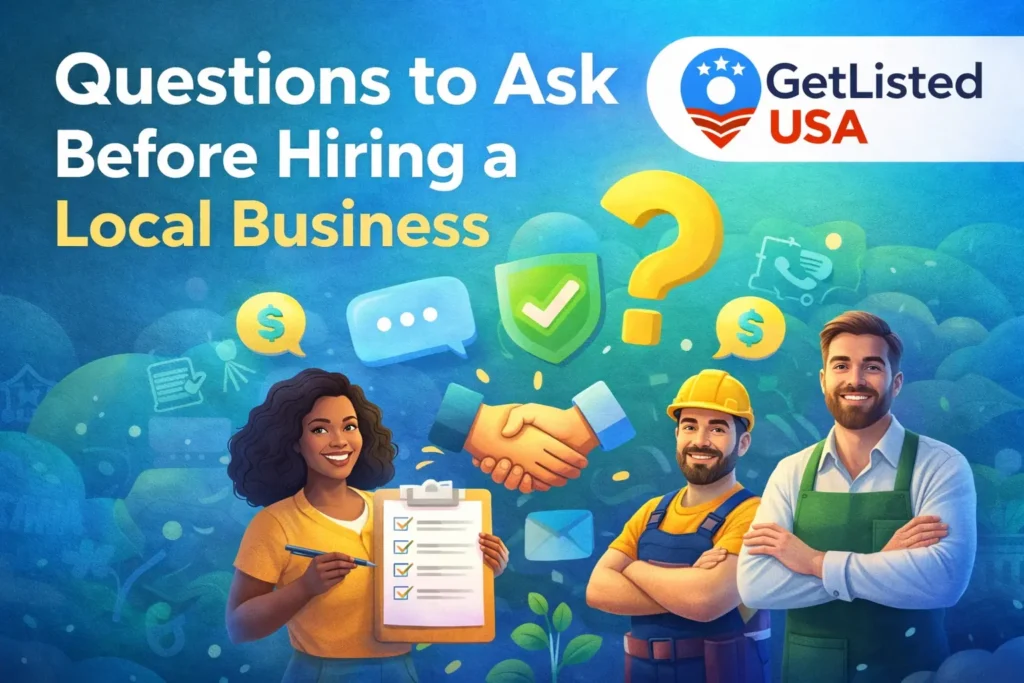
You’ve found a local business that looks promising. The website seems professional, the reviews are decent, and the price feels right. But before you pick up the phone or sign anything, stop. Asking the right questions upfront can be the difference between a smooth experience and a costly mistake.
Whether you’re hiring a local contractor for a home renovation, booking a restaurant for a private event, or bringing in a service provider for the first time, a few smart questions will tell you everything you need to know about whether a business deserves your trust and your money.
Before hiring any local business, ask about their experience and how long they’ve operated in your area, whether they are licensed and insured (for trade services), what their pricing includes and what could change it, how they handle complaints or unsatisfactory work, and whether they can provide references from recent local clients. For restaurants or shops, ask about their sourcing, reservation policies, and how they handle special requests. Always verify answers independently where possible.
And if you’re a local business owner reading this, these are the questions your customers are already thinking. Make sure your GetListedUSA listing answers them before they even have to ask.
Why Asking Questions Before You Hire Actually Matters
Asking questions before hiring a local business protects you from poor workmanship, hidden costs, and unreliable service. It also helps businesses that do quality work stand out — and gives you confidence in your decision before any money changes hands.
Most bad experiences with local businesses share one thing in common: the customer didn’t ask enough questions before committing. It’s not that the warning signs weren’t there — it’s that no one thought to look for them.
According to the Better Business Bureau, complaints against service businesses consistently top their annual reports, and the majority involve issues that a direct conversation upfront could have flagged. Unclear pricing. No written scope of work. No license verification. A contractor who disappears after taking a deposit.
The good news is that legitimate businesses, the kind listed on trusted directories like GetListedUSA, welcome these questions. They’re confident in their work, transparent about their process, and happy to earn your trust. Any business that gets defensive when you ask basic questions is telling you something important.
General Questions to Ask Any Local Business Before Hiring
Before hiring any local business, ask how long they’ve been operating in your area, what’s included in their price, how they handle problems or complaints, whether they have references, and what their payment terms are. These five questions alone will filter out most unreliable providers.
These questions apply universally, whether you’re hiring a cleaner, a caterer, a landscaper, or a repair technician. Make them your standard starting point.
1. How Long Have You Been in Business in This Area?
Longevity in a local market is a meaningful signal. A business that has operated in your city or neighborhood for five or more years has weathered competition, built repeat customers, and maintained a local reputation worth protecting. New businesses aren’t automatically unreliable, but they carry more unknowns.
What to listen for: Specific years, local community involvement, any mention of repeat or referred customers.
2. Can You Provide References From Recent Local Clients?
Any business worth hiring should be able to provide at least two or three references from customers in your area within the past 12 months. If they can’t or won’t, that’s a red flag, not a minor inconvenience.
What to listen for: Willingness to share references without hesitation. When you follow up with references, ask specifically about the timeline, communication, and whether the final cost matched the quote.
3. What Does Your Price Include and What Could Change It?
“The price” often isn’t the final price. Ask what’s explicitly included in the quote, and more importantly, what scenarios could increase the cost. Materials? Travel fees? Overtime? Permits? A transparent business will walk you through this clearly. A vague answer here is a preview of invoice surprises later.
4. Do You Have Any Current Reviews or Ratings I Can Check?
Rather than just googling them yourself, ask the business directly where their reviews are. It tells you a lot about their confidence level. Cross-check their response against what you find on Google, Yelp, and GetListedUSA. Consistent ratings across multiple platforms signal authenticity.
5. How Do You Handle Complaints or Unsatisfactory Work?
Every business occasionally falls short. What separates the good ones from the bad ones is how they respond when it happens. Ask directly: what is their policy if you’re not satisfied? A clear, confident answer — money-back guarantee, free redo, direct escalation path — is a strong trust signal.
Questions to Ask Before Hiring a Local Contractor or Service Provider
Before hiring a local contractor or service provider in the USA, always ask if they are licensed and insured in your state, what the project timeline looks like, who will actually perform the work, and whether they provide a written contract. These questions protect you legally and financially.
For trade-based and skilled service providers, plumbers, electricians, HVAC technicians, roofers, and general contractors, the stakes are higher. The questions below go beyond the basics.
Read Also: How to Find the Best Local Businesses Near You
6. Are You Licensed and Insured in This State?
This is non-negotiable for any licensed trade. Licensing requirements vary by state, but in most of the USA, plumbers, electricians, contractors, and HVAC technicians are required to hold a valid state license. Ask for their license number and verify it yourself through your state’s licensing board website.
Why it matters: If an unlicensed contractor damages your property or causes injury, you may have no legal recourse — and your homeowner’s insurance could refuse to cover the claim.
7. Will You Provide a Written Contract or Scope of Work?
Any legitimate service provider should be willing to put the scope of work, timeline, payment schedule, and warranty terms in writing. If they resist or say ‘we just do it on a handshake,’ walk away. A written agreement protects both parties and removes ambiguity about what was promised.
8. Who Will Actually Be Doing the Work?
This question catches a common issue: businesses that win your job and then subcontract it to someone you’ve never vetted. Ask specifically whether the people who show up will be employees of the company or subcontractors — and if subcontractors, whether they are also licensed and insured.
9. What Is the Estimated Timeline, and What Could Delay It?
Get a realistic timeline and ask what factors could extend it — weather, material delays, permit approvals. A contractor who gives you an honest answer with built-in contingencies is more trustworthy than one who promises an unrealistically tight schedule just to win the job.
10. What Does Your Warranty or Guarantee Cover?
Ask specifically: what is covered, for how long, and what process do you follow if something goes wrong after the work is complete? Labor warranties and material warranties are different things — make sure you understand both. Get it in writing as part of the contract.
Questions to Ask Before Hiring a Local Restaurant or Shop
Before booking a local restaurant for an event or choosing a local shop for a significant purchase, ask about their experience with similar events or orders, their cancellation and refund policy, how they handle dietary restrictions or special requests, and what their deposit terms look like.
Hiring a local restaurant for a private event, a catering order, or a special occasion is a different kind of decision — but the stakes can be just as high. The same goes for commissioning a local shop for a custom product or large order.
According to Emplifi Resources, around 48% of customers follow restaurants or food brands on social media, and a large portion prefers online ordering and digital interaction, meaning transparency and communication are more important than ever.
11. Have You Handled Events or Orders Similar to Mine Before?
Experience with your specific type of request matters. A restaurant that’s hosted hundreds of private dinners is a very different proposition from one doing it for the first time. Ask for examples, photos, or references from similar past events or orders.
12. What Is Your Cancellation and Refund Policy?
Life happens. Before you put down a deposit on a catered event or a custom order, understand exactly what happens if you need to cancel or reschedule. Get the policy in writing — ideally as part of a simple booking agreement.
13. How Do You Accommodate Dietary Restrictions or Special Requests?
For restaurants and caterers especially, this question reveals how flexible and customer-focused the business really is. A good local restaurant will welcome the conversation. A shop taking a custom order should be clear about what customization is and isn’t possible before you commit.
14. What Are Your Deposit Terms and Payment Schedule?
For significant bookings or orders, most local businesses require a deposit — typically 25–50% upfront. That’s reasonable. What you’re looking for is a clear, written breakdown of when payments are due and what triggers the final payment. Avoid any arrangement where 100% payment is required before the service is delivered.
The One Question Every Consumer Should Always Ask
15. Why Should I Choose You Over Other Local Options?
This question does double duty. It invites the business to sell themselves and it reveals a lot about their confidence, communication style, and self-awareness. A business that gives you a compelling, specific answer (not just ‘we have great customer service’) understands its own value proposition. That kind of clarity tends to carry over into how they handle the actual work.
It also signals to the business that you’re an informed consumer who has done your research — which, in turn, tends to bring out their best effort.
| Your Pre-Hire Checklist at a Glance
Save or screenshot this checklist before your next local hire: |
| ✓ How long in business locally? | ✓ Warranty/guarantee details? |
| ✓ Written contract provided? | ✓ Licensed & insured? (trades) |
| ✓ References from recent clients? | ✓ Deposit & payment terms clear? |
| ✓ Who does the actual work? | ✓ Reviews verified across platforms? |
| ✓ What does the price include? | ✓ Special requests accommodated? |
| ✓ Realistic timeline confirmed? | ✓ Cancellation/refund policy? |
| ✓ How are complaints handled? | ✓ Why choose them vs. others? |
Are You a Local Business Owner? Make These Questions Easy to Answer.
The consumers reading this guide are your future customers. They’re doing their research — and if your business isn’t easy to find and doesn’t clearly communicate your credentials, experience, and trustworthiness, they’ll hire someone who does.
Getting listed on GetListedUSA puts your business in front of local consumers who are actively looking for reliable, vetted service providers in your area and it gives you a platform to answer their questions before they even have to ask.
List Your Business on GetListedUSA — Free →
FAQs
What is the most important question to ask before hiring a local contractor?
Always start with licensing and insurance: “Are you licensed and insured in this state?” For trade services in the USA, this is non-negotiable. An unlicensed contractor puts your property, your safety, and your legal rights at risk. Verify the license number independently through your state’s licensing board.
Should I always get a written contract before hiring a local business?
For any service costing $500 or more, yes — always get a written contract. It doesn’t need to be a complex legal document. A simple written scope of work, price, timeline, and warranty terms protects both you and the business. Verbal agreements are almost impossible to enforce if something goes wrong.
How do I know if a local business’s reviews are genuine?
Look for reviews that are specific — mentioning names, timelines, or project details. Genuine reviews tend to be spread out over time, not clustered in a single week. Cross-check ratings across Google, Yelp, and GetListedUSA. A business with consistent ratings across multiple platforms is far more trustworthy than one with a perfect score on just one site.
Is it okay to negotiate the price with a local business?
Absolutely — and most local businesses have more flexibility than national chains. It’s completely reasonable to ask whether there’s room to adjust pricing, especially for larger jobs or if you’re paying upfront. Just be respectful and don’t use negotiation as a red flag screening tool — a firm price isn’t a sign of dishonesty.
What should I do if a local business refuses to answer my questions?
Move on. A legitimate, confident business will welcome your questions; they’re an opportunity to build trust. If a business becomes evasive, defensive, or dismissive when you ask about licensing, references, or their warranty, that’s a clear signal. Use GetListedUSA to find verified local alternatives in your area.
How many quotes should I get before hiring a local service provider?
For any job over $500, get at least three quotes. This isn’t just about finding the lowest price, it’s about understanding the market rate, what’s included at each price point, and which business communicates most clearly. A quote that’s significantly lower than two others is worth questioning before accepting.
Ready to Find a Local Business You Can Actually Trust?
Now that you know exactly what questions to ask, the next step is finding local businesses worth asking. GetListedUSA makes it easy to discover verified local service providers and businesses across all 50 states, organized by category and location, so you can find reliable options near you without sifting through paid ads.
And if you’re a business owner who can confidently answer every question in this guide, submit your business to GetListedUSA today and let your next customer find you before they find your competition.